|
|
 |  |
 |
|
|
|
Location
Lying entirely in the northern hemisphere, the mainland extends between latitudes 8°4' and 37°6' north, longitudes 68°7' and 97°25' east, and measures about 3,214 km from north to south between the extreme latitudes and about 2,933 km from east to west between the extreme longitudes. It has a land frontier of about 15,200 km. The total length of the coastline of the mainland, Lakshadweep Islands, and the Andaman and Nicobar Islands is 7,516.6 km.
Capital
New Delhi
|
| Map |
 |
|
Geography
It covers an area of 32,87,263 sq km, extending from the snow-covered Himalayan heights to the tropical rain forests of the south. As the seventh largest country in the world, India stands apart from the rest of Asia, marked off as it is by mountains and the sea, which give the country a distinct geographical entity. Bounded by the Great Himalayas in the north, it stretches southwards and at the Tropic of Cancer, tapers off into the Indian Ocean between the Bay of Bengal on the east and the Arabian Sea on the west.
Climate : The climate of India may be broadly described as tropical monsoon type.
There are four seasons:
- winter (January-February)
- hot weather summer (March-May);
- rainy southwestern monsoon (June-September) and
- post-monsoon, also known as northeast monsoon in the southern Peninsula (October-December).
India's climate is affected by two seasonal winds - the northeast monsoon and the southwest monsoon. The north-east monsoon, commonly known as winter monsoon blows from land to sea, whereas south-west monsoon, known as summer monsoon blows from sea to land after crossing the Indian Ocean, the Arabian Sea, and the Bay of Bengal. The south-west monsoon brings most of the rainfall during a year in the country.
Population
India's population, as on 1 March 2001 stood at 1,028 million (532.1 million males and 496.4 million females). India accounts for a meagre 2.4 per cent of the world surface area of 135.79 million sq km. Yet, it supports and sustains a whopping 16.7 per cent of the world population.
The population of India, which at the turn of the twentieth century was around 238.4 million, increased to reach 1,028 million at the dawn of the twenty-first century. The population of India, as recorded at each decennial census from 1901, has grown steadily except for a decrease during 1911-21.
The per cent decadal growth of population in the inter-censal period 1991-2001 varies from a low of 9.42 in Kerala to a very high 64.41 in Nagaland. Delhi with 46.31 per cent, Chandigarh with 40.33 per cent, and Sikkim with 32.98 per cent registered very high growth rates. In addition to Kerala, Tamil Nadu and Andhra Pradesh registered low growth rates during 1991-2001. The per cent decadal growth rate has declined during the census decade 1991-2001, as compared to the previous census decade, in all the States/Union Territories except Haryana, Uttar Pradesh, Bihar, Sikkim, Nagaland, Manipur, Gujarat, Daman and Diu, and Dadra and Nagar Haveli. The States and Union Territories that have shown increases in per cent decadal growth together constitute about 32 per cent of India's population.
Flag of India
 |
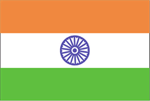
The National Flag is a horizontal tricolour of deep saffron (kesaria) at the top, white in the middle and dark green at the bottom in equal proportion. The ratio of width of the flag to its length is two to three. In the centre of the white band is a navy-blue wheel which represents the chakra. Its design is that of the wheel which appears on the abacus of the Sarnath Lion Capital of Ashoka. Its diameter approximates to the width of the white band and it has 24 spokes. The design of the National Flag was adopted by the Constituent Assembly of India on 22 July 1947.
(Source: National Portal of India at India.gov.in) |
National Symbol : Burung Garuda (Eagle)
 |
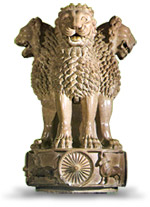
The state emblem is an adaptation from the Sarnath Lion Capital of Ashoka. In the original, there are four lions, standing back to back, mounted on an abacus with a frieze carrying sculptures in high relief of an elephant, a galloping horse, a bull and a lion separated by intervening wheels over a bell-shaped lotus. Carved out of a single block of polished sandstone, the Capital is crowned by the Wheel of the Law (Dharma Chakra) .
In the state emblem, adopted by the Government of India on 26 January 1950, only three lions are visible, the fourth being hidden from view. The wheel appears in relief in the centre of the abacus with a bull on right and a horse on left and the outlines of other wheels on extreme right and left. The bell-shaped lotus has been omitted. The words Satyameva Jayate from Mundaka Upanishad, meaning 'Truth Alone Triumphs', are inscribed below the abacus in Devanagari script. |
National Day :
- Republic Day: 26th January is celebrated as the Republic day in India. This commemorates the declaration of India as a Republic and coming into force of its constitution on 26th January 1950.
- Independence Day: 15th August is celebrated as Independence Day as India achieved independence from British Colonial rule on 15th August 1947.
History of India :
INDIA is one of the oldest civilizations in the world with a kaleidoscopic variety and rich cultural heritage. The oldest historical evidences date back to Neolithic Age when Mehrgarh and Kotdiji in North-Western part of India was habitated in nearly 7000BC. There are specific evidences of rice cultivation in those days. Similar evidences are also found in parts of Central India in Narmada valley which is believed to be inhabited in 9000 BC.
However, the most well known example is that of Indus Valley Civilization which flourished in 2600 to 1900 BC. It is well known for its town planning, trade and urbanization. This was followed by the so called Aryan invasion from the North West which led to the destruction of the old civilization and gave birth to the new civilization in the region of Ganga-Yamuna doab. It was called the Vedic Age. It coincided with the Iron Age. It flourished from 1500 to 500 BC.
The later part of the Vedic Age saw the establishment of the Mahajanapadas and the dawn of the Maurya Empire. This was followed by the Guptas, Gahadawalas, Parmaras in the north, Gaudas and Palas in the East, Rashtrakutas, Satavahanas in the West and Central part and the Cholas, Cheras and Pandyas in the South.
Around 700 AD, Muhammad Bin Kasim’s invasion of the Sindh heralded the beginning of the medieval history in India. This followed the invasion by Muhammad Ghori and finally the establishment of the Sultanat in Delhi. This was followed by the Slave dynasty, the Lodhis and finally the Mughals with the invasion by Babur in 16th Century. The Mughal rule lasted for nearly 400 years and was finally brought to an end in 1858 when the last Emperor, Bahadur Shah Jafar was interned and transported to Burma.
The invasion by Western colonial powers started in 16 th Century with the Portuguese followed by the Dutch, the French and finally the British. All of them barring the Dutch were successful in creating their colonies in India with the British being the most successful as they were able to establish the British Empire which lasted for nearly 150 years.
On 15th August 1947, after a long struggle for independence spanning over 150 years and led by such illustrious leaders of the Freedom Struggle like Mahatma Gandhi, Pandit Jawaharlal Nehru and Vallabbhai Patel, India became independent.
On 26th January 1950, India was declared a Republic and its constitution came into force.
Languages :
There are 22 languages which are recognized by the Constitution of India in its Eighth schedule. The Union Government uses Hindi and English as the languages for official use.
|
|
|
|
|
Indian political system is a multiparty parliamentary democracy. The President is the Head of State who is elected by the electoral college of people’s representative with a method of proportional representation. He is the head of State and performs his duties in consultation and advice of the Cabinet of Ministers.
The Prime Minister is the head of Government by the virtue of the fact that he heads the Cabinet of Ministers. The Lok Sabha and Rajya Sabha are called the Lower and the Upper house respectively. The Lok Sabha has 545 members, out of which, barring two, all are elected by the people directly. The Rajya Sabha members are elected by the legislators of the State and Union Territories and some of them (12) are nominated by the President.
The Vice President of India is the Ex-Officio Chairman of the Rajya Sabha while the Speaker heads the Lok Sabha.
There are major National Political parties like Indian National Congress, Bhartiya Janata Party, Samajwadi Party and Bahujan Samaj Party besides major State parties like Dravida Munnetra Kazagam, All India Anna Dravid Munnetra Kazagam, Telugu Desam Party, Shivsena, Rashtriya Janata Dal and the Communist Parties like CPI and CPI (Marxist).
The most recent elections to the Lok Sabha were held in 2004. The Indian national Congress emerged as the single largest party and is presently ruling with the help of its alliances as a part of United Progressive Alliance (UPA). The National Democratic Alliance (NDA) led by the Bhartiya Janata Party (BJP) is the opposition.
|
|
|
|
|
| Economy – Overview: |
 |
Half a Century after gaining its independence, India has overcome all odds and achieved phenomenal standards of economic stability, courtesy the indomitable contributions of various sectors such as agriculture, tourism, commerce, power, communications, science & technology, etc., which have acted as the pillars of the Indian economy. India is today one of the six fastest growing economies of the world. The country is ranked fourth in terms of Purchasing Power Parity (PPP) in 2001. The business and regulatory environment is evolving and moving towards constant improvement. |
| GDP – Real Growth Rate: |
 |
The second quarter (July-September) of the financial year 2005-06 registers a growth rate of 8 percent. |
| GDP – Purchasing Power Parity: |
 |
India is the fourth largest economy, with US$ 3 trillion GDP in terms of Purchasing Power Parity (PPP) after USA, China, and Japan. |
| GDP – Per Capita: |
 |
As of September 2005, the GDP per capita of the Country stood at US$ 543. |
| GDP – Composition by Sector: |
 |
Services 56%, Agriculture 22%, and Industry 22% (As of September 2005). |
| Labour Force: |
 |
According to the Report of the Committee on India Vision: 2020, India’s labour force has reached approximately 375 million in 2002. |
| Unemployment Rate: |
 |
9.1% (As of Sep 2005) |
| Population below Poverty Line: |
 |
26.10% as on 1999-2000 |
| Inflation Rate: |
 |
4.1% as on July 2005. |
| Public Debt: |
 |
The total Debt as on 31st March 2002 stands at Rs. 1372117.58 crores. |
| Exchange Rates: |
 |
|
| Agriculture Products: |
 |
Rice, wheat, tea, cotton, sugarcane, potatoes, jute, oilseed, poultry, etc. |
| Industries: |
 |
Steel, garments, petroleum, cement, machinery, locomotive, food processing, pharmaceutical products, mining, etc. |
| Currency (Code): |
 |
Indian Rupee (INR) |
| Fiscal Year: |
 |
1st April to 31st March. |
( For latest Economic indicators visit the link www.finmin.nic.in)
|
|
|
|
|
With a wide range of climatic conditions from the torrid to the arctic, India has rich and varied vegetation, which only a few countries of comparable size possess. India can be divided into eight distinct-floristic-regions, namely, the western Himalayas, the eastern Himalayas, Assam, the Indus plain, the Ganga plain, the Deccan, Malabar and the Andamans.
The Western Himalayan region extends from Kashmir to Kumaon. Its temperate zone is rich in forests of chir, pine, other conifers and broad-leaved temperate trees. Higher up, forests of deodar , blue pine, spruce and silver fir occur. The alpine zone extends from the upper limit of the temperate zone of about 4,750 metres or even higher. The characteristic trees of this zone are high-level silver fir, silver birch and junipers. The eastern Himalayan region extends from Sikkim eastwards and embraces Darjeeling, Kurseong and the adjacent tract. The temperate zone has forests of oaks, laurels, maples, rhododendrons, alder and birch. Many conifers, junipers and dwarf willows also occur here. The Assam region comprises the Brahmaputra and the Surma valleys with evergreen forests, occasional thick clumps of bamboos and tall grasses. The Indus plain region comprises the plains of Punjab, western Rajasthan and northern Gujarat. It is dry and hot and supports natural vegetation. The Ganga plain region covers the area which is alluvial plain and is under cultivation for wheat, sugarcane and rice. Only small areas support forests of widely differing types. The Deccan region comprises the entire tableland of the Indian Peninsula and supports vegetation of various kinds from scrub jungles to mixed deciduous forests. The Malabar region covers the excessively humid belt of mountain country parallel to the west coast of the Peninsula. Besides being rich in forest vegetation, this region produces important commercial crops, such as coconut, betel nut, pepper, coffee and tea, rubber and cashew nut. The Andaman region abounds in evergreen, mangrove, beach and diluvia forests. The Himalayan region extending from Kashmir to Arunachal Pradesh through Nepal, Sikkim, Bhutan, Meghalaya and Nagaland and the Deccan Peninsula is rich in endemic flora, with a large number of plants which are not found elsewhere.
India is rich in flora. Available data place India in the tenth position in the world and fourth in Asia in plant diversity. From about 70 per cent geographical area surveyed so far, 47,000 species of plants have been described by the Botanical Survey of India (BSI), Kolkata. The vascular flora, which forms the conspicuous vegetation cover, comprises 15,000 species. Of these, more than 35 per cent is endemic and has so far not been reported anywhere in the world. The flora of the country is being studied by the BSI and its nine circle/field offices located throughout the country along with certain universities and research institutions.
India is also rich in minerals especially iron ore, coal, bauxite,limestone, mica, manganese and thorium.
|
|
|
|
|
The long span of Indian history covering more than 3000 years and enumerating several civilizations has been a constant reminder of the country's rich multicultural extravaganza and world-renowned heritage. The people and their lifestyles, their dance forms and musical styles,
art & handicrafts, and such other elements go on to reflect the varied hues of Indian culture and heritage, which truly epitomises the nationality of the country. This section attempts at showcasing all those elements, which act as a window to the culture and heritage of India.
The Indian literary tradition is the oldest in the world. It is primarily one of verse and essentially oral. The earliest works were composed to be sung or recited, and were so transmitted for many generations before being written down.
Sanskrit Literature
India has 22 officially recognised languages, and a huge variety of literature has been produced in these languages over the years. Hindu literary traditions dominate a large part of Indian culture. Apart from the Vedas, which are a sacred form of knowledge, there are other works such as the Hindu epics Ramayana and Mahabharata, treatises such as Vaastu Shastra in architecture and town planning, and Arthashastra in political science. The most famous works in Sanskrit are the Hindu holy texts like the Vedas, Upanishads, and Manusmriti. Another popular literature, Tamil literature has a rich literary tradition spanning over 2000 years, and is particularly known for its poetic nature in the form of epics, and philosophical and secular works.
Other great literary works, which marked the golden era of Indian literature, include ‘Abhijanam Shakuntalam’ and ‘Meghdoot’ by Kalidasa, ‘Mricchakatika’ by Shudraka, ‘Svapna Vasavadattam’ by Bhaasa, and ‘Ratnavali’ by Sri Harsha. Some other famous works are Chanakya's ‘Arthashastra’ and Vatsyayana's ‘Kamasutra’.
The most famous works of the Indian literature can be traced in the vernacular languages of the northern Indian cults of Krishna and of Rama. Also included are the 12th-century poems by Jaydev, called the 'Gitagovinda' and religious love poems written in Maithili (eastern Hindi of Bihar). Literature was also produced in the form of Bhakti (a personal devotion to a god) addressed to Rama (an avatar of Vishnu), most notably in the Avadhi (eastern Hindi) works of Tulsi Das; his ‘Ramcharitmanas’. The early gurus or founders of the Sikh religion, especially Guru Nanak Dev and Guru Arjun Dev, also composed bhakti hymns to their concepts of deity.
In the 16th century, the Rajasthani princess and poet Mira Bai addressed her bhakti lyric verse to Krishna, as did the Gujarati poet Narsimh Mehta.
Hindi Literature
Hindi literature started as religious and philosophical poetry in medieval periods in dialects like Avadhi and Brij. The most famous figures from this period are Kabir and Tulsidas. In modern times, the Khadi dialect became more prominent and a variety of literature was produced in Sanskrit.
Chandrakanta, written by Devaki Nandan Khatri, is considered to be the first work of prose in Hindi. Munshi Premchand was the most famous Hindi novelist. The other famous poets include Maithili Sharan Gupt, Jaishankar Prasad, Sumitranandan Pant, Mahadevi Varma, and Ramdhari Singh 'Dinkar'.
In the British era, a literary revolution occurred with the influence of Western thought and the introduction of printing press. Purposeful works were being written to support the cause of freedom struggle and to remove the existing social evils. Ram Mohan Roy's campaign for introduction of scientific education in India and Swami Vivekananda's works are considered to be great examples of the English literature in India.
During the last 150 years, many writers have contributed to the development of modern Indian literature, written in a number of regional languages as well as in English. One of the greatest Bengali writers, Rabindranath Tagore became the first Indian to win the Nobel Prize for literature (Gitanjali) in 1913.
Tribal and folk art
Tribal art, like folk art, has also progressed considerably due to the constant developmental efforts of the Indian government and other organizations. Tribal art generally reflects the creative energy found in rural areas that acts as an undercurrent to the craftsmanship of the tribal people. Tribal art ranges through a wide range of art forms, such as wall paintings, tribal dances, tribal music, and so on.
India had always been known as the land that portrayed cultural and traditional vibrancy through its conventional arts and crafts. The 35 states and union territories sprawled across the country have their own distinct cultural and traditional identities, and are displayed through various forms of art prevalent there. Every region in India has its own style and pattern of art, which is known as folk art. Other than folk art, there is yet another form of traditional art practiced by several tribes or rural population, which is classified as tribal art. The folk and tribal arts of India are very ethnic and simple, and yet colorful and vibrant enough to speak volumes about the country's rich heritage.
Folk art in India apparently has a great potential in the international market because of its traditional aesthetic sensibility and authenticity. The rural folk paintings of India bear distinctive colorful designs, which are treated with religious and mystical motifs. Some of the most famous folk paintings of India are the Madhubani paintings of Bihar, Patachitra paintings from the state of Orissa, the Nirmal paintings of Andhra Pradesh, and other such folk art forms. Folk art is however not restricted only to paintings, but also stretches to other art forms such as pottery, home decorations, ornaments, cloths-making, and so on. In fact, the potteries of some of the regions of India are quite popular among foreign tourists because of their ethnic and traditional beauty. Moreover, the regional dances of India, such as the Bhangra dance of punjab, the Dandiya of Gujarat, the Bihu dance of Assam, etc, which project the cultural heritage of those regions, are prominent contenders in the field of Indian folk art. These folk dances are performed by people to express their exhilaration on every possible event or occasion, such as the arrival of seasons, the birth of a child, weddings, festivals, etc. The government of India, as well as other societies and associations, have therefore made all efforts to promote such art forms, which have become an intrinsic part of India's cultural identity.
The famous Folk and Tribal Art of India:
 Tanjore Art
 Madhubani Painting
 Warli Folk Painting
 Pattachitra Painting
 Rajasthani Miniature Painting
 Kalamezhuthu
The famous Classical Dances of India:
 Bharatanatyam
 Kathakali
 Kathak
 Odissi
 Manipuri
 Mohiniattam
 Kuchipudi
 Kutiyattam
The famous Folk Dances of India:
 Bhangra
 Bhortal Nritya
 Bhavai
 Bihu
 Garba
 Kummi
 Poikkal Kudirai Attam
 Devarattam
 Thabal Chongba
 Chhau
 Jatra
 Yakshagana
 Cheraw
The roots of the Indian music can be traced back to the Vedic period, when the celestial creator of the universe, Brahma was said to have handed down music to the world through his son, sage Narada, to usher in an era of peace and solace among humanity. Music is one of the oldest forms of art, which has been reflecting the richness of Indian culture and tradition throughout ages. Right from the evolution of music, there have been many developmental phases in its path, which have redefined the creative enormity and infiniteness of the art.
New historical and cultural research has shown that Indian music has progressed through a very intricate communication between different people practising different traditions and cultures. The amalgamation of the musical styles of various races in the country displays the ethnic diversity of India, which is found nowhere in any other nation.
The earliest form of music was used during the Vedic period as sacred hymns, which were chanted through a method called "Ek Swari Gaayana," meaning singing with the help of one note. The single note hymns gradually developed to the "Gatha Gaayana" method of singing with double notes. Eventually, the Vedic chants of the single note, double notes, and such other systems gave way to the initiation of the seven note system called "Saptaswara". Modern studies of the Vedic period reveal that music had been regarded as a highly previleged art form in every household, as it had been handed down to them by the Gods themselves. In this context, the glory of the Gupta period reverberates throughout the history of Indian music as one of the most important contributors to the development of Indian music.
The evolution of modern-day Indian music, or "Sangeet," as it is popularly known in the country, has simplified the art form through various innovations. Indian music has essentially been known to be performed through three modes - vocal music, instrumental music, and dance. All the three mediums of music are prevalent in the two prominent kinds of Indian classical music, namely the North Indian classical music or the Hindustani classical music, and the classical music of South India or the Carnatic music, as well as other folk music.
Hindustani Music :
The history of Hindustani classical music is said to have originated during the period of the Indus Valley Civilization, although the only evidencial support to the claim are the recovery of the famous bronze dancing girl from that period and the customary worshipping of Rudra or Shiva, the God of dance, drama, and music. After the decline of the Indus Valley Civilization came the stage of the Vedic music, in which sacrifices and prayers were made to the Gods through hymns and chants in musical style. Moreover, music was one of the key factors in the creation of two of the greatest of Indian epics, the Ramayana and the Mahabharata. Music in India, from the transitional period to the modern age has witnessed tremendous development in style and methodology. Great musicians in the history of Indian music, such as Kalidasa, Tansen, Amir khusrou, etc. have contributed immensely to the progress of Indian music, the reputation of which is still being maintained in the modern era by musical stalwarts like Pandit Ravi Shankar, Bhimsen Gururaj Joshi, Pandit Jasraj, Prabha Atre, Sultan Khan, Zakeer Hussain, and so on.
Carnatic Music :
The south Indian form of Indian classical music is known as Carnatic music, and is a musical style performed with the company of several musical instruments, such as violin, veena, mridangam, etc. Carnatic music is prevalent in the south Indian states of Tamil Nadu, kerala, Andhra pradesh and Karnataka. Carnatic music follows a pattern of mainly devotional themes, most of which are sung in the praise of Hindu deities. The prime components of Carnatic music follows the same pattern as any other Indian classical music, which are the Raga, implying the melody part, and the Tala, denoting the rhythmic part. Musical instruments are an intrinsic part of Carnatic music, and have strengthened the foundation of this art form at the hands of immaculate musicians like T.R. Mahalingam, M. Chandrasekaran, and so on. Some of the proponents of Carnatic classical music have created waves in the international circuit through their immortal compositions and have been bestowed with several awards and commemorations, thus making them legends in the field. Some of these doyens of carnatic music include the names of M.S. Subbulakshmi, Madurai Mani Iyer, M.S. Balasubramanya Sarma, and so on.
|
|
|
|
|
All the key websites of President, Prime Minister, various union ministries, and Departments etc. can be found from the following link-www.nic.in under the link goi directory
References
1. Official website of Government of India - www.india.gov.in
2. Official website of the Ministry of External Affairs - www.mea.gov.in |
|
|
|
|